


Full-Grain, Corrected-Grain and Split Leather in Handmade Shoes: How to Evaluate Quality Beyond Marketing Claims
Shipping & Returns
 Free Delivery
 Easy 7 Day Return
 COD Available
Choosing premium leather shoes involves more than comparing designs, colours and prices. The type of leather used in a shoe affects its appearance, ageing, durability, maintenance and overall value. However, leather terminology can be confusing, especially when brands use words such as premium, genuine, natural and handcrafted without explaining what they mean.
For buyers investing in hand stitched leather shoes, understanding the differences between full-grain, corrected-grain and split leather can make it easier to assess quality before purchasing a pair. These leather types have different characteristics, and each can serve a particular purpose when selected and processed correctly.
This guide explains how these materials differ, what to check when buying handcrafted leather shoes, and how to look beyond marketing claims to make an informed decision.
What Determines the Quality of Leather Used in Shoes?
Leather quality depends on several factors, not just the type of hide used. The animal's age, the condition of its skin, the area from which the leather is cut, the tanning process, the finishing method and the thickness all influence the final material.
The construction of the shoe also matters. High-quality leather cannot compensate for poor stitching, an unsuitable shoe last or an incorrectly attached sole.
When assessing leather shoes, consider these five factors:
- Grain structure: The condition and characteristics of the hide's original outer surface.
- Leather thickness: Whether the material is suitable for the intended part of the shoe.
- Tanning and finishing: How the leather has been processed, coloured and protected.
- Flexibility and temper: How the leather bends and responds to pressure.
- Construction quality: How the leather is cut, stitched, lasted and assembled into the finished shoe.
Understanding these factors helps buyers judge the material on its actual qualities rather than relying on a product description alone.
What Is Full-Grain Leather?
Full-grain leather retains the hide's original grain surface without being sanded or buffed to remove surface imperfections. The grain layer contains a dense network of fibres that contributes to the leather's strength and characteristic appearance.
Because the surface remains largely intact, natural markings may be visible. These can include small scars, wrinkles, variations in grain and differences in texture. Such features are not necessarily defects. They may be natural characteristics of the hide.
Why is full-grain leather valued in handmade shoes?
Full-grain leather is widely used in premium footwear because it can combine strength, an attractive natural surface and the ability to develop character with wear.
Its main advantages include:
- Natural appearance: The original grain provides texture and variation that can be difficult to reproduce artificially.
- Potential for long-term wear: Properly selected and processed full-grain leather can withstand regular use.
- Ageing characteristics: Some full-grain leathers develop a patina, particularly when they have an appropriate finish and are maintained correctly.
- Repair potential: Quality uppers can often be cleaned, conditioned, polished and repaired when the damage is limited and the leather remains structurally sound.
However, full-grain leather is not automatically superior in every application. Its performance depends on hide selection, tanning, finishing, thickness and the way it is used in the shoe.
For example, full-grain leather with poor temper or unsuitable thickness may crease badly or feel uncomfortable. A well-finished corrected-grain leather may be more practical for buyers who prefer a consistent appearance and easier maintenance.
How to assess full-grain leather
Look closely at the surface under natural light. The grain should have a convincing texture rather than an entirely uniform, artificial appearance. Check whether the product description identifies the leather type and finish clearly.
Also examine the leather around the vamp, which is the part covering the front of the foot. This area bends repeatedly during walking. The leather should be appropriate for the shoe's design and should not feel excessively stiff or fragile.
Remember that natural markings alone cannot prove that leather is full-grain. Reliable product specifications and clear information from the manufacturer are more useful than appearance alone.
What Is Corrected-Grain Leather?
Corrected-grain leather is made from a hide whose grain surface has been mechanically altered, usually through sanding or buffing, to reduce visible imperfections. A finishing layer, pigment or embossed grain pattern may then be applied to create a more consistent appearance.
The degree of correction varies. Some corrected-grain leather has a subtle finish, while other types have a more heavily coated surface.
Why is corrected-grain leather used in footwear?
Natural hides are not perfectly uniform. Correcting the surface allows manufacturers to produce leather with a consistent colour and texture across a batch of shoes.
This makes corrected-grain leather useful for footwear where a neat, uniform appearance is important.
Its potential advantages include:
- Consistent appearance: Colour and surface texture can be more uniform across different pairs.
- Reduced visibility of minor surface marks: Pigmented finishes can conceal some imperfections.
- Practical maintenance: Certain finished leathers are easier to wipe clean and may resist surface staining better than more absorbent finishes.
- Design flexibility: Embossing and pigmentation allow manufacturers to create specific visual effects.
The main consideration is the finish itself. A heavily coated surface may show scuffs differently from an uncoated or lightly finished leather. Depending on the coating, scratches can expose a contrasting layer beneath the surface.
Corrected-grain leather is not necessarily low quality. Its performance depends on the quality of the underlying hide, the extent of correction and the finishing system used.
How to evaluate corrected-grain leather
Ask whether the leather has a pigmented, coated or embossed finish. Check how the surface responds to gentle flexing and inspect the finish around stitched areas, edges and folds.
Look for uneven coating, peeling or cracking in a new shoe. These may indicate a finishing problem, although a visual inspection cannot reveal every issue.
Buyers should also consider the intended use. Corrected-grain leather may suit formal footwear that needs a consistent appearance and straightforward cleaning. However, those who prefer a more natural grain and gradual patina may prefer a suitable full-grain leather.
What Is Split Leather?
Split leather is produced when a hide is separated into layers. The upper layer retains the original grain surface, while the lower layer is known as the split.
Split leather does not have the same original grain surface as full-grain leather. It may be used in its natural form, finished with pigments, or treated to create a suede-like texture.
One common example is suede, which is produced by finishing a suitable leather surface to create a soft, napped texture. Suede can be made from different layers of a hide, including splits.
Another category is coated split leather, which may receive an artificial surface layer to imitate the appearance of grain leather. The properties of this material depend on the base leather and the coating.
Is split leather suitable for shoes?
Yes. Split leather can be suitable for particular footwear applications when the material is selected and finished appropriately.
Its characteristics may include:
- A soft, textured surface, particularly in suede.
- A different balance of flexibility and strength compared with grain leather.
- Suitability for casual shoes, selected boots and decorative panels.
- Greater dependence on finishing when a smooth, grain-like appearance is desired.
However, split leather should not be treated as interchangeable with full-grain leather. The structure of the material differs, and a coated split may behave differently from suede or an uncoated split.
How to identify split leather
The surface appearance alone may not provide a reliable answer, especially when a coating has been applied. Ask the manufacturer to specify whether the product uses full-grain, corrected-grain or split leather.
If a shoe is described simply as leather, that wording does not establish which part of the hide was used. Buyers should look for a clear material description rather than assuming that a smooth surface indicates full-grain leather.
Full-Grain vs Corrected-Grain vs Split Leather
The following comparison highlights the main differences buyers should understand.
|
Feature |
Full-grain leather |
Corrected-grain leather |
Split leather |
|
Surface |
Original grain retained |
Grain surface altered, often with added finish |
Lower layer of the hide |
|
Appearance |
Natural variations may be visible |
Often more uniform |
Depends on finishing, from suede-like to coated |
|
Ageing |
May develop a natural patina |
Depends on the coating and finish |
Depends on the material and treatment |
|
Maintenance |
Depends on the finish |
Often straightforward with suitable care |
Suede and coated splits require different care methods |
|
Main consideration |
Hide quality and suitability |
Quality of the underlying leather and finish |
Intended application and finishing quality |
No single category guarantees that a shoe will last longer than every shoe made from another category. The quality of the leather, the design, the construction and the conditions of use all influence the result.
How to Evaluate Leather Quality Beyond Marketing Claims
Terms such as premium leather, luxury leather and genuine leather do not provide enough information to judge the material's quality. Buyers should look for specific details and inspect the finished product carefully.
Check the material description
A useful product description should identify the leather type wherever possible. Look for details about the upper, lining and insole rather than assuming that every component uses the same material.
For example, a shoe may have a leather upper but a synthetic lining or a different material in its sole assembly. These distinctions can affect comfort, breathability and repair options.
Examine the vamp and flex areas
The vamp bends repeatedly during walking, so the leather used here needs to suit the shoe's design. Look for excessive stiffness, visible finish separation or obvious damage.
Natural creasing is expected in leather footwear. The pattern depends on the leather, the shoe's fit, the shape of the last and the way the wearer walks. Creasing alone does not establish poor quality.
Inspect the stitching and finishing
In hand stitched leather shoes, examine the consistency of the stitching, the alignment of the sole and the finish around the edges. Check that the upper sits properly against the sole and that there are no obvious gaps or loose threads.
Visible stitching can indicate careful workmanship, but it does not prove that every part of the shoe is hand-stitched. Ask about the construction method if this distinction matters to you.
Assess the fit
Even excellent leather can feel uncomfortable when the shoe does not fit correctly. Check the toe room, heel grip, instep pressure and width across the forefoot.
Leather may soften with wear, but a shoe should not depend on substantial stretching to correct severe pressure points. A suitable last and accurate sizing are essential for long-term comfort.
Understand the finish and care requirements
Different finishes require different care methods. Smooth pigmented leather, lightly finished full-grain leather and suede should not be treated in the same way.
Use products suitable for the specific leather finish. Excessive conditioning, unsuitable cleaners and heavy wax application can affect the surface. Test any new care product on an inconspicuous area first.
Does Leather Type Matter More Than Shoe Construction?
Leather selection and shoe construction work together. Neither should be assessed in isolation.
A shoe made with good-quality leather may still have a short service life if its sole attachment, heel construction or fit is poor. Likewise, a well-constructed shoe cannot compensate for leather that is unsuitable for the intended use.
Goodyear welted construction, for example, attaches the upper and insole assembly through a welt, which is then joined to the outsole. This construction can allow the outsole to be replaced without rebuilding the entire shoe, provided the welt, upper and other components remain in suitable condition.
Blake-stitched and other constructions have their own characteristics, including differences in flexibility, profile and repair methods.
When comparing handcrafted leather shoes, assess the material and the construction separately. Ask what type of leather is used, how the sole is attached, whether resoling is possible and what maintenance the manufacturer recommends.
This approach gives a more complete picture of the shoe's expected performance than relying on a single label.

Choosing Leather for Handmade Boots and Formal Shoes
The best leather depends on the footwear's purpose.
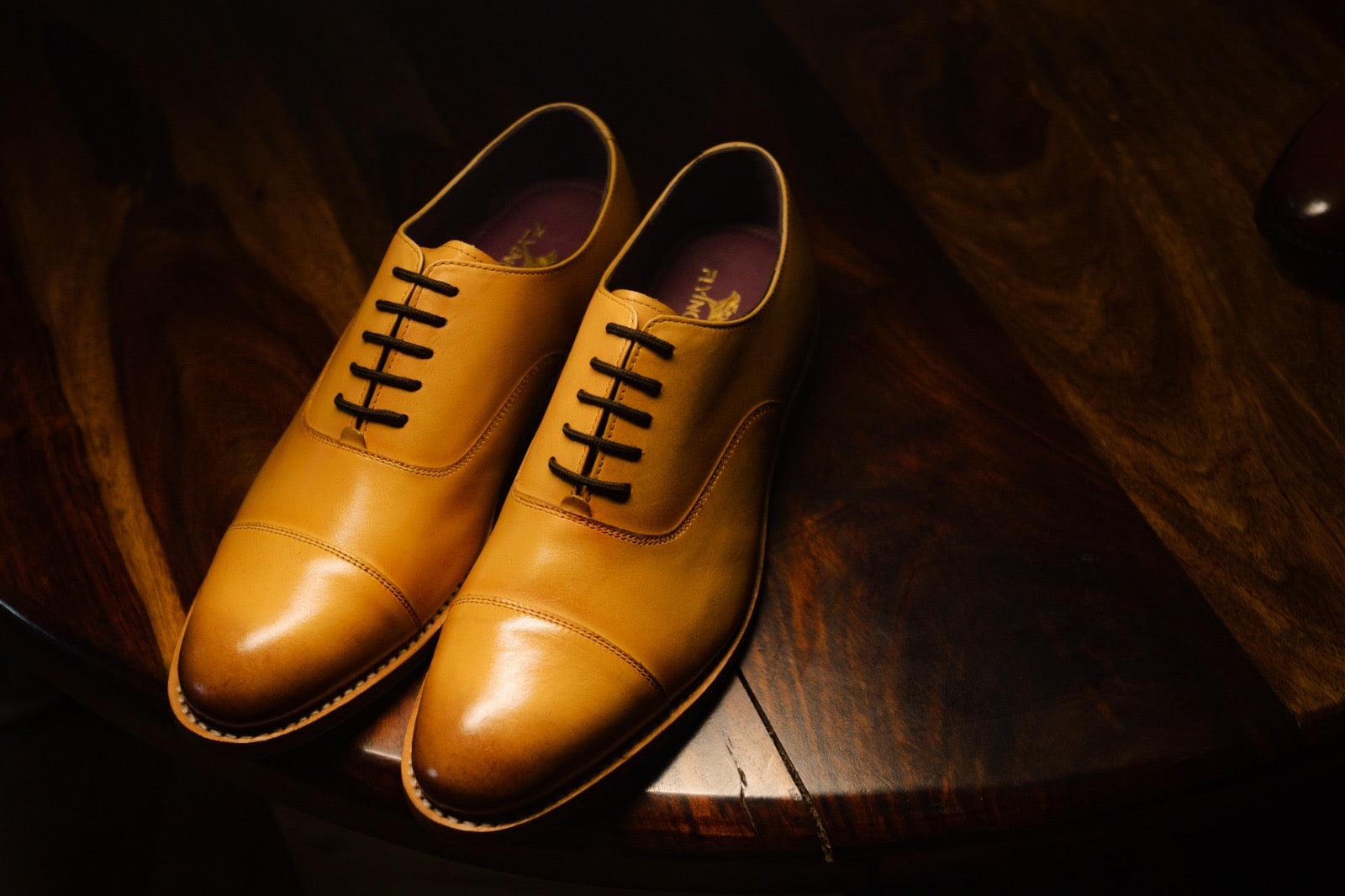
For formal Oxford shoes, many buyers prefer smooth leather with a refined finish. A suitable full-grain leather may offer natural character, while quality corrected-grain leather can provide a consistent appearance.
For casual Derby shoes and loafers, the choice may depend on how formal the design needs to look, the desired finish and the amount of maintenance the owner is willing to undertake.
Handmade boots may require leather selected for the boot's structure, intended conditions and level of support. Buyers should consider the leather's thickness, flexibility, lining, sole construction and resistance to everyday wear.
Suede can work well for casual footwear, but it needs appropriate care, particularly when exposed to mud and heavy rain. Similarly, smooth leather should not be assumed to be waterproof simply because it has a polished or coated surface.
Rather than choosing a shoe based on the leather category alone, consider where you will wear it, how frequently you will use it and how much maintenance you can provide.
Finding the Right Balance Between Quality and Price
The most expensive leather shoe is not automatically the best choice for every buyer. Price may reflect material selection, skilled labour, construction, finishing, production scale and brand positioning.
When comparing products, look beyond the initial price. Consider how the shoe fits, whether the material suits your needs, how the sole is attached and whether repair services are available.
Buyers searching for the best handmade leather shoes in India should compare these factors rather than relying entirely on product descriptions or promotional claims. The same principle applies when searching for the best handmade leather shoes in India for office wear, formal occasions or regular use.
A well-made shoe should offer a suitable combination of material quality, construction, fit and practical maintenance. Clear product information helps buyers understand what they are paying for and whether the footwear meets their expectations.
Why Choose Flying Hawk for Handcrafted Leather Footwear?
At Flying Hawk, we value traditional shoemaking, carefully selected materials and footwear designed around lasting style. Our experience in the leather footwear industry spans more than 90 years, across five generations of industry involvement. We offer a range of Goodyear welted shoes and boots, including formal Oxfords, brogues, Derby shoes, loafers and Chelsea boots. We also provide a Goodyear welted resoling service to help customers maintain suitable footwear over time. When choosing a pair from our collection, we encourage customers to consider the leather, construction, fit and care requirements together so they can make an informed decision based on their needs.
Conclusion
Understanding the differences between full-grain, corrected-grain and split leather helps buyers evaluate footwear more carefully. Full-grain leather retains its original grain surface, corrected-grain leather has an altered surface, and split leather comes from a lower layer of the hide. Each has distinct characteristics and potential uses.
However, leather type is only one part of the decision. Tanning, finishing, thickness, shoe construction, fit and maintenance all influence how a pair performs over time.
Before purchasing handcrafted leather shoes, check the material specifications, inspect the workmanship and consider how the footwear will be used. These steps will help you choose a pair that suits your requirements, offers practical value and can be maintained properly for years to come.
Frequently Asked Questions
1. What is the difference between full-grain, corrected-grain and split leather?
Full-grain leather retains the hide's original grain surface, while corrected-grain leather has a surface that has been sanded or buffed and may receive an additional finish. Split leather comes from the lower layers of the hide and can be finished as suede or coated leather.
2. Are full-grain leather shoes better than corrected-grain leather shoes?
Not always. Full-grain leather offers a natural surface and may develop a patina with wear. Corrected-grain leather can provide a more uniform appearance and practical maintenance. The better choice depends on the leather's quality, finish, intended use and the shoe's construction.
3. How can I identify high-quality leather in handcrafted shoes?
Check the material specifications, surface finish, flexibility and stitching. Examine the vamp for obvious defects and assess the shoe's fit, sole attachment and overall finishing. Natural markings alone cannot confirm leather quality, so clear information from the manufacturer is important.
4. Is full-grain leather suitable for handmade boots and formal shoes?
Yes. Full-grain leather can be suitable for both formal shoes and handmade boots, provided its thickness, flexibility and finish match the design. The intended use, construction method and expected exposure to moisture should also influence the choice.
5. What should I look for when buying the best handmade leather shoes in India?
Look for clearly specified leather, reliable construction, comfortable fit, neat finishing and suitable after-sales care. Consider the climate in which you will wear the shoes, the maintenance required and whether the soles can be repaired or replaced. These factors provide a better basis for comparison than price or marketing claims alone.
SIZE GUIDE
| Size (UK) |
Size (EU) |
Foot Length (cm) |
|---|---|---|
| 5 | 39 | 24.8 |
| 5.5 | 39.5 | 25.1 |
| 6 | 40 | 25.4 |
| 6.5 | 40.5 | 25.7 |
| 7 | 41 | 26 |
| 7.5 | 41.5 | 26.6 |
| 8 | 42 | 27.3 |
| 8.5 | 42.5 | 27.6 |
| 9 | 43 | 27.9 |
| 9.5 | 43.5 | 28.5 |
| 10 | 44 | 29.2 |
| 10.5 | 44.5 | 29.5 |
| 11 | 45 | 29.8 |
| 11.5 | 45.5 | 30.2 |
| 12 | 46 | 30.5 |
| 12.5 | 46.5 | 30.9 |

- Choosing a selection results in a full page refresh.
- Opens in a new window.