


How to Identify Good Leather in Premium Formal Shoes Before You Buy
Shipping & Returns
 Free Delivery
 Easy 7 Day Return
 COD Available
A formal shoe can look impressive in a product photograph and still leave you wondering about its quality once it arrives. Leather quality is one of the biggest factors behind the appearance, feel, ageing and maintenance requirements of a pair of formal shoes. However, judging leather is not as simple as looking for a particular colour, shine or price tag.
If you are comparing premium formal shoes men India buyers have available, it helps to understand what you are actually paying for. The type of leather, how it has been finished, its surface characteristics, construction and how it is likely to age all matter.
Whether you are browsing men's formal shoes online or visiting a footwear store, knowing what to check can help you make a more informed purchase. This guide explains the practical signs of good leather and the details worth checking before buying formal Shoes for men.
Start With the Type of Leather
The first thing to establish is what type of leather the shoe uses. Terms such as full-grain, top-grain, corrected-grain and genuine leather can refer to different levels of processing and should not be treated as interchangeable descriptions.
Full-grain leather generally retains the natural grain of the hide because the outer surface has not been heavily sanded or corrected. This can allow natural variations and markings to remain visible. With appropriate care, certain full-grain leathers can develop a distinctive patina as they are worn.
Top-grain leather has also been produced from the outer portion of the hide, but its surface may have undergone some correction or finishing. The result can be a more uniform appearance.
Corrected-grain leather is processed more extensively to alter or even out the surface. It can still produce an attractive and consistent shoe, but the finish tells you less about the natural characteristics of the underlying hide.
When assessing a pair, do not judge quality from the leather label alone. Ask how the leather has been finished and consider its appearance, flexibility, consistency and construction as a whole.
Look at the Grain and Surface
Good leather does not necessarily have a perfectly uniform surface.
Natural leather can show subtle variations in grain, pores and texture. These variations are not automatically defects. In fact, an excessively uniform surface may indicate that the leather has been heavily corrected or coated.
Run your eyes across the vamp, quarters and other visible sections of the shoe. Look for a surface that appears consistent without looking excessively plastic or artificial.
The grain should also correspond reasonably across adjacent sections. Minor differences are normal because hides are natural materials. What you want to avoid is leather that appears brittle, excessively coated or unevenly finished.
A highly polished formal shoe may have a smooth, glossy appearance because of its finishing process. Therefore, shine by itself should never be used as proof of leather quality.
Examine How the Leather Bends
Flexibility is another useful indicator when examining formal footwear.
Gently flex the forepart of the shoe, without forcing it beyond its normal movement. Quality leather should bend rather than feel like a rigid sheet. When a shoe creases naturally during flexing, the crease should not immediately appear excessively cracked or sharply broken.
This does not mean that good leather will never crease. Leather shoes are expected to develop creases where the foot naturally bends. The depth and appearance of those creases depend on several factors, including leather characteristics, shoe fit, pattern design and the wearer's gait.
If the surface coating appears to crack sharply when the shoe bends, it is worth examining the finish more closely. A surface that remains supple and cohesive under normal movement is generally preferable for a formal shoe intended for regular use.
Check the Leather Thickness and Structure
Thickness is important, but thicker does not automatically mean better.
A formal shoe needs leather that works appropriately with its design and construction. Very thin leather may provide a different feel and structure compared with a shoe made from a more substantial upper. At the same time, unnecessarily thick leather can make certain footwear less flexible.
Look at how the upper holds its shape. The vamp and quarters should have sufficient structure for the shoe's design rather than collapsing easily when handled.
The lining also matters. A well-made formal shoe typically considers both the outer leather and the materials used inside the shoe. The upper, lining, insole, welt or other construction components need to work together.
This is why leather should never be assessed separately from the shoe's overall construction.
Inspect the Edges and Finishing
Finishing provides useful clues about how carefully a shoe has been made.
Look closely at the leather edges around the quarters, vamp, heel and other visible areas. The finishing should appear clean and deliberate. Excessive glue marks, uneven colouring, rough edges or inconsistent polishing can indicate shortcomings in manufacturing or finishing.
Pay particular attention to areas where different components meet. On a well-finished formal shoe, these transitions should look neat rather than hurried.
The sole edge and heel should also be considered. A premium appearance comes from the combination of good materials and precise workmanship, not simply from the leather itself.
If you are buying men's formal shoes online, enlarged product photographs can help you inspect these details. If the website does not show useful close-up images, checking the product description or contacting the seller for construction and material information can be worthwhile.
Do Not Confuse Shine With Leather Quality
One of the easiest mistakes when shopping for formal footwear is assuming that a highly polished shoe must use better leather.
A strong shine can be created through polishing and finishing techniques. A shoe with a softer natural appearance may actually provide a clearer view of the leather's grain and characteristics.
Different leather finishes are also designed for different visual effects. Some formal shoes are intentionally polished to create a sleek appearance, while others retain a more natural texture.
Instead of asking whether the leather is shiny, ask:
- Does the surface look natural or excessively coated?
- Does the leather flex without the finish cracking?
- Is the colour consistent?
- Does the shoe maintain its structure?
- Are the edges and seams neatly finished?
- Is the leather type clearly disclosed?
These questions give you a much better basis for evaluating a shoe.
Look for Natural Variation
Leather comes from an animal hide, so small variations can be perfectly normal.
You may notice slight differences in grain, texture or colour between the left and right shoe. Small natural marks do not necessarily indicate poor quality. In some cases, they are simply evidence of the natural material.
The key is to distinguish natural variation from manufacturing problems.
Deep scars, major surface damage, severe creasing before wear or inconsistent finishing across prominent areas deserve closer attention. Minor variations, on the other hand, should not automatically be treated as defects.
This distinction is particularly important when comparing premium footwear. The objective is not to find a piece of leather that looks completely synthetic and identical from every angle. It is to find leather that has been selected and finished appropriately for the shoe.
Understand How Leather Ages
Another useful question is how the leather is likely to look after months or years of wear.
Certain leather types develop patina, meaning the colour and character evolve through use, polishing and exposure. Brown and tan leathers can be particularly interesting in this respect because their appearance may change with regular conditioning and polishing.
Black leather can also develop changes in surface character, although its appearance is generally more uniform.
Ageing is not necessarily deterioration. Properly maintained leather can develop character over time. However, the way it ages depends on the leather, finish, construction, environment and care routine.
For buyers in India, climate and usage also deserve consideration. Heat, humidity, rain, dust and frequent commuting can all affect leather footwear. Keeping shoes clean, allowing them to dry naturally and using suitable shoe-care products can help maintain the leather.
Check the Construction Alongside the Leather
A good upper cannot compensate for poor overall construction.
When evaluating premium formal footwear, look at how the upper is attached to the sole. Construction methods such as Goodyear welting and hand welting are different from simpler cemented construction and can affect how the shoe is structured, maintained and repaired.
A Goodyear welted shoe, for example, uses a welt as part of the connection between the upper, insole and sole assembly. One practical advantage of this type of construction is that the shoe can be designed with resoling in mind.
This is particularly relevant if you are considering a more substantial investment in formal footwear. You should not only ask, "Is the leather good?" Ask, "How is the entire shoe made?"
The leather, last, stitching, welt, sole, heel, lining and finishing all contribute to the finished product.
Consider the Price, But Do Not Use It as Proof
Price can provide context, but it does not prove leather quality.
A higher price may reflect better materials, skilled labour, construction, finishing, brand positioning or other costs. Conversely, an expensive shoe is not automatically made from superior leather.
When you buy men's formal shoes online, compare the information provided by different brands. Look for specific details about the leather and construction instead of relying on phrases such as "luxury", "premium" or "high quality".

A useful comparison should consider:
|
What to check |
Why it matters |
|
Leather type |
Indicates the material and level of surface processing |
|
Grain and texture |
Helps assess the character and finish of the leather |
|
Flexibility |
Shows how the upper responds to normal movement |
|
Surface finish |
Helps identify excessive coating or poor finishing |
|
Edge finishing |
Indicates attention to manufacturing detail |
|
Construction |
Affects structure, durability and potential repairability |
|
Lining |
Contributes to internal finish and wearing comfort |
|
Sole and heel |
Affect the overall structure and intended use |
|
Care requirements |
Helps you understand long-term maintenance |
What to Check When Buying Online
Buying men's formal shoes online requires a slightly different approach because you cannot physically touch the leather before placing an order.
Start with the product description. Look for the exact leather type, construction method, sole material and other relevant specifications.
Then examine product photographs carefully. Look at close-up images of the vamp, quarters, toe, stitching, sole edge and heel. If all photographs are distant or heavily edited, it becomes harder to assess the actual material.
Also check the brand's return and exchange policy, especially when purchasing your first pair. Fit is separate from leather quality, and even a well-made shoe will not perform as intended if the size or shape is unsuitable for your feet.
Do not hesitate to contact the seller with specific questions. Instead of asking whether a shoe is "premium", ask what leather is used, how the upper is constructed and what type of sole is fitted.
Common Leather Buying Mistakes to Avoid
Several common assumptions can make it harder to identify a genuinely suitable formal shoe.
Assuming expensive means better: Price needs to be considered alongside materials and workmanship.
Choosing based only on shine: Polishing and finishing can dramatically change the appearance of leather.
Expecting leather to have no creases: Creasing is a normal part of wearing leather footwear.
Ignoring construction: The upper is only one part of a formal shoe.
Treating every natural mark as a defect: Minor variations can be normal characteristics of natural leather.
Ignoring care requirements: Even good leather needs appropriate cleaning, conditioning and storage.
Buying only from photographs: Product images are useful, but material specifications and construction details provide additional information.
How to Make a More Informed Purchase
When comparing formal Shoes for men, create a simple checklist before making your decision.
First, identify the leather type and finish. Then examine the surface and grain. Check how the upper flexes and whether it maintains its structure. Inspect the stitching, edges and sole attachment. Finally, consider the construction, fit, intended use and care requirements.
This approach is more reliable than choosing a shoe based on appearance alone.
For buyers searching for premium formal shoes men India, these details become particularly important because formal footwear is often purchased for repeated use at offices, meetings, events, weddings and other occasions. A well-considered purchase should therefore account for how the shoe will look and function beyond the first few wears.
Our Approach at Flying Hawk
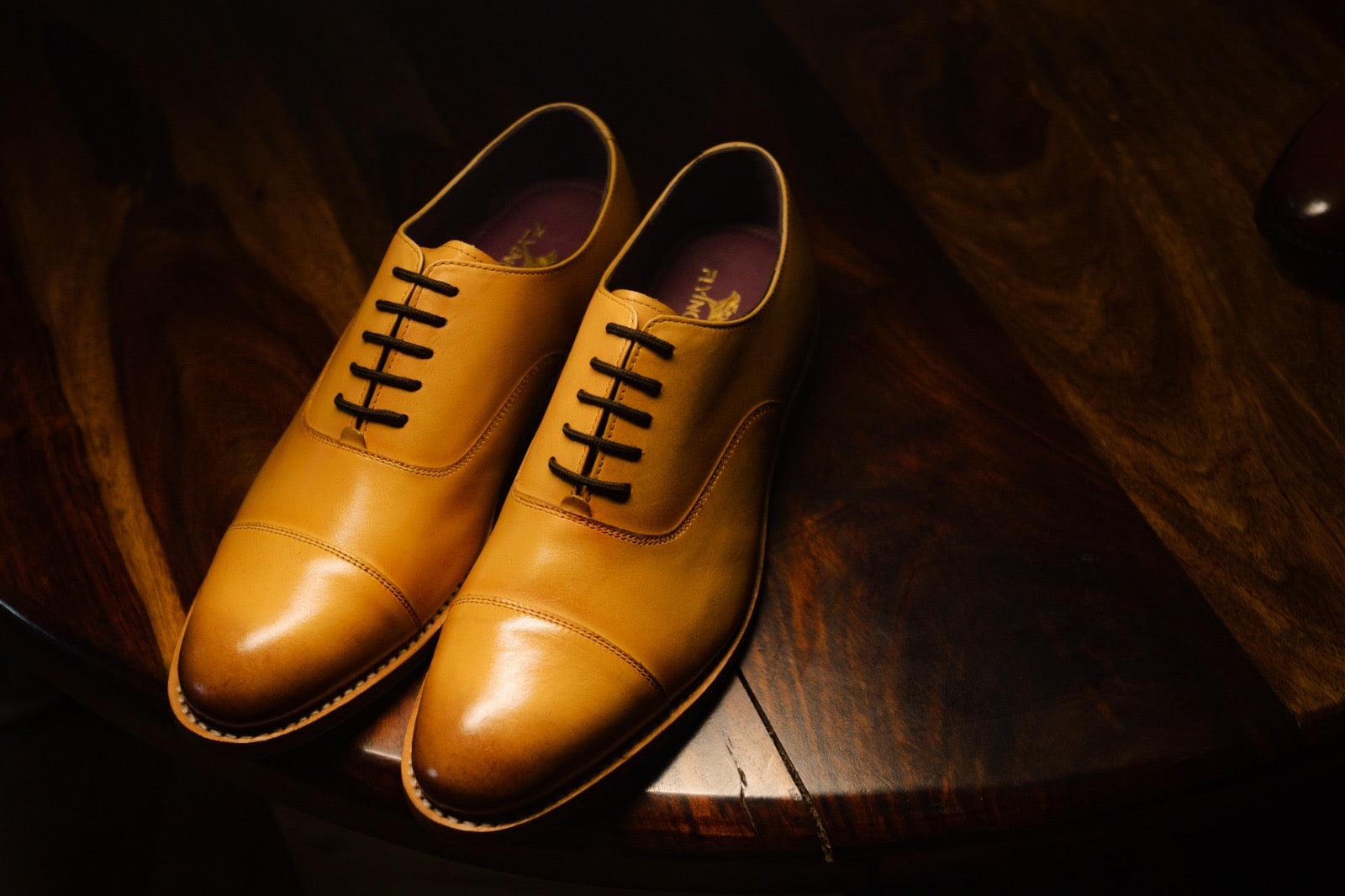
At Flying Hawk, we focus on the relationship between leather, construction and craftsmanship rather than treating any one feature as the definition of a premium shoe. Our footwear is made with carefully selected leather and traditional shoemaking techniques, with Goodyear welted construction forming an important part of our collection. Our facility and craftsmen bring fifth-generation footwear expertise and more than 90 years of experience in leather shoe making research and craftsmanship. We also offer Goodyear welted resoling services because we believe a well-made pair should be considered with long-term ownership in mind. Our range includes Oxfords, Derbies, Brogues, Monk shoes, Loafers and boots, giving men different options for formal and refined everyday dressing.
Conclusion
Identifying good leather before buying formal shoes requires more than checking the price or looking for a glossy finish. Examine the leather type, grain, flexibility, surface treatment and finishing. Then look beyond the upper and assess the shoe's construction, sole, lining, stitching and overall workmanship.
When you buy men's formal shoes online, product specifications and detailed photographs become especially important. When shopping in person, use the opportunity to examine the leather closely and assess how it feels and bends.
A premium formal shoe should make sense as a complete product. Good leather is important, but its value becomes clearer when it is combined with appropriate construction, careful finishing, suitable fit and proper maintenance. By knowing what to look for, you can make a more informed choice and select formal footwear that suits both your wardrobe and the way you intend to wear it.
Frequently Asked Questions
1. How can I tell if the leather used in formal shoes is good quality?
Check the leather type, grain, surface finish, flexibility, consistency and edge finishing. Good leather should feel supple, maintain the shoe's structure and show a well-executed finish without an excessively plastic appearance.
2. Does expensive leather always mean better formal shoes?
No. Price alone does not determine leather quality. The construction, finishing, workmanship, sole, lining and overall design should be considered alongside the leather used.
3. Is creasing a sign of poor-quality leather?
Not necessarily. Creasing is normal where leather bends as you walk. Its appearance depends on the leather, shoe design, fit and how the footwear is worn and maintained.
4. What should I check when buying leather formal shoes online?
Check the exact leather type, construction method, sole material and product specifications. Examine close-up photographs for the grain, stitching and finishing, and review the brand's return and exchange policy before placing your order.
5. Is Goodyear welted construction important when buying premium leather formal shoes?
Construction is an important consideration because it affects the structure, maintenance and potential repairability of the shoe. Goodyear welted construction is one established method that can allow a shoe to be resoled, making it relevant for buyers considering long-term ownership.
SIZE GUIDE
| Size (UK) |
Size (EU) |
Foot Length (cm) |
|---|---|---|
| 5 | 39 | 24.8 |
| 5.5 | 39.5 | 25.1 |
| 6 | 40 | 25.4 |
| 6.5 | 40.5 | 25.7 |
| 7 | 41 | 26 |
| 7.5 | 41.5 | 26.6 |
| 8 | 42 | 27.3 |
| 8.5 | 42.5 | 27.6 |
| 9 | 43 | 27.9 |
| 9.5 | 43.5 | 28.5 |
| 10 | 44 | 29.2 |
| 10.5 | 44.5 | 29.5 |
| 11 | 45 | 29.8 |
| 11.5 | 45.5 | 30.2 |
| 12 | 46 | 30.5 |
| 12.5 | 46.5 | 30.9 |

- Choosing a selection results in a full page refresh.
- Opens in a new window.